

Oil Resistant Conveyor Belts: Reliable Solutions for Demanding Industrial Applications

Introduction
Oil resistant conveyor belts are specially designed to handle materials containing oils, grease, fats, and other oily substances in demanding industrial environments. Unlike conventional rubber conveyor belts, these belts use specially formulated rubber compounds that help resist oil penetration, swelling, softening, and premature deterioration.
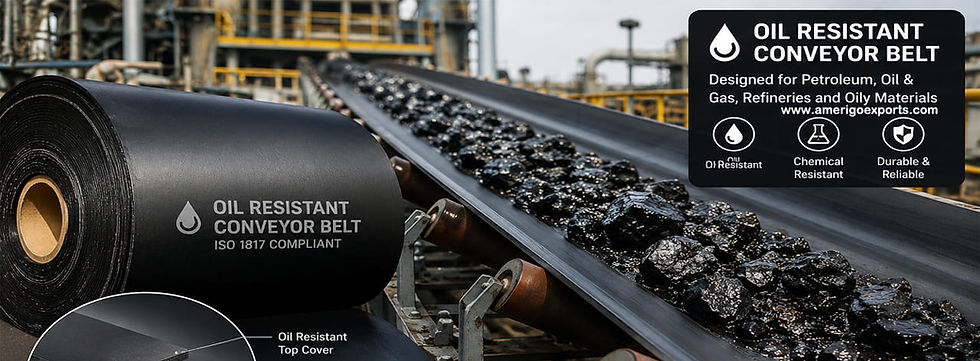
Amerigo Exports offers a range of industrial conveyor belt solutions designed to meet the material-handling requirements of various industries. Oil resistant conveyor belts are an ideal choice for applications where exposure to mineral oils, lubricants, animal fats, vegetable oils, and oily industrial materials can affect the performance and service life of standard conveyor belts.
What Is an Oil Resistant Conveyor Belt?
An oil resistant conveyor belt is an industrial belt manufactured using oil-resistant rubber compounds, commonly based on nitrile rubber (NBR) or other suitable elastomer blends. These compounds are selected to help the belt maintain its strength, flexibility, and performance when exposed to specified oils and oily materials.
The level of oil resistance depends on the rubber compound, the type of oil, temperature, exposure duration, and operating conditions. Selecting the right belt is essential for reliable material handling and reduced maintenance costs.
Key Features of Oil Resistant Conveyor Belts
Oil-resistant rubber cover: Helps reduce swelling and deterioration caused by compatible oils and oily materials.
Abrasion resistance: Supports reliable performance when conveying abrasive materials.
High tensile strength: Provides strength for demanding industrial conveying applications, depending on belt construction.
Flexibility: Allows smooth movement around conveyor pulleys when correctly designed for the system.
Longer service life: The appropriate oil-resistant compound can help reduce premature belt replacement.
Reliable material handling: Supports continuous industrial operations under suitable working conditions.
Customisable construction: Available in different widths, thicknesses, reinforcement types, and cover grades according to application requirements.
Applications of Oil Resistant Conveyor Belts
1. Recycling and Waste Management
Used for conveying oily scrap, contaminated materials, and selected industrial waste streams, subject to chemical compatibility.
2. Automotive Industry
Suitable for handling metal components, automotive parts, and materials carrying cutting oils, lubricants, or grease.
3. Food Processing Industry
Oil-resistant belts can be used for conveying materials containing vegetable oils, animal fats, and other food-related oily substances. For direct food contact, the belt must also meet applicable food-contact requirements.
4. Oil and Lubricant Industries
Used in selected material-handling systems where components or conveyed materials come into contact with lubricants and compatible oily substances.
5. Fertiliser and Chemical Industries
Suitable for certain oily raw materials and industrial products when the belt compound is verified as compatible with the chemicals being conveyed.
6. Metalworking and Engineering Industries
Useful for conveying metal chips, machined components, and other materials that may carry cutting fluids or industrial lubricants.
7. Agricultural and Oilseed Processing
Used in suitable applications involving oilseeds, oily residues, and processed agricultural materials.
Types of Oil Resistant Conveyor Belts
Oil-resistant conveyor belts can be selected according to the material being conveyed and the severity of oil exposure.
Light oil-resistant belts: For applications involving relatively mild oil exposure.
Medium oil-resistant belts: For industrial materials containing moderate amounts of compatible oils and grease.
High oil-resistant belts: For demanding applications requiring greater resistance to specific oils, subject to compound selection and testing.
Oil-resistant food-grade belts: For food-processing applications that require both oil resistance and compliance with relevant food-contact standards.
These categories are descriptive rather than universal grades. Buyers should confirm the manufacturer's actual resistance classification and technical specifications.


Comments